
Meie edu nurgakivi
In elevator guide rail selection, the price difference between solid and hollow guide rails often puzzles procurement professionals—a solid rail can cost several times or even more than a hollow rail of the same length. This price gap is not accidental, but is determined by multiple factors including manufacturing processes, material consumption, precision requirements, and performance standards.
Solid guide rails are machined rails, manufactured by machining the guide surfaces and connection areas from rail profiles. The production process includes: profile rolling → aging treatment → machining of guide surfaces → end-dimension machining → final straightening → inspection.
Two key steps in the manufacturing of solid guide rails significantly drive up costs:
First, thorough aging treatment. High-precision solid guide rails require sufficient aging treatment of the profiles before machining the guide surfaces to reduce residual stresses; a second aging treatment is performed before machining end dimensions and final straightening to fully release internal stresses. These procedures are time-consuming and labor-intensive, but effectively prevent rail deformation caused by stress release after installation.
Second, precision machining. Critical areas such as guide surfaces and end tenons must be finished by machine tools. For high-precision rails, the tolerances for guide surface dimensions, rail height, and tenon symmetry are all improved from the original 0.1 mm to 0.05 mm. This level of precision can only be achieved through precise machining.
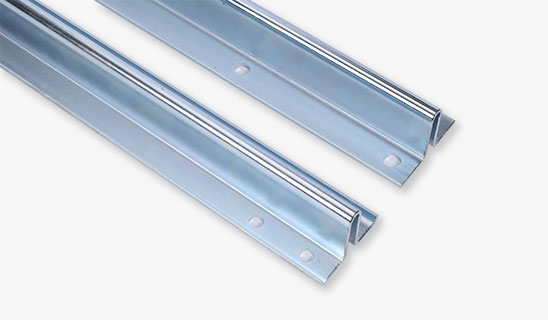
Hollow guide rails are cold-roll-formed rails, made by passing coil strip through multiple-pass roll-forming dies. The manufacturing process is relatively simple: coil uncoiling → continuous cold-roll forming → cutting → inspection.
Hollow guide rails are roll-formed using cold-forming mills. Their special structural design not only meets functional requirements but also makes installation, use, and replacement more convenient. Cold-roll forming allows continuous production with high material utilization, fewer processing steps, shorter lead times, and no need for complex machining equipment or prolonged aging treatments.
The cost gap between the two processes: Solid rails involve profile rolling, multiple aging treatments, precision machining, and other steps—requiring large equipment investment, long production cycles, and high labor time per piece. Hollow rails, in contrast, are continuously cold-roll formed from coil, with high automation, fast production speeds, and simple processes. One complex, one simple—the cost difference is inherently substantial.
Solid guide rails are manufactured from full-section solid steel, with a dense structure and complete material fill. Taking common T-section rails as an example, they are classified by weight per meter into grades such as 8K, 13K, 18K, 24K, 30K, and 50K—with weights ranging from 8 kg to 50 kg per meter. For the same length, solid rails consume far more steel than hollow rails.

Hollow guide rails have a hollow interior, achieving efficient material utilization through optimized structural design. Compared with solid rails, hollow rails can reduce weight by more than 30%. The coil strip is cold-formed into a hollow section, significantly saving steel while maintaining adequate strength.
Direct comparison of material costs: For the same rail length, the steel consumption of a solid rail can be 1.5 times or even more than that of a hollow rail. Given high steel prices, the raw-material cost difference alone is considerable.
In elevator systems, the guide rails installed on the car side are typically solid rails. These rails serve not only to guide the elevator car but also to withstand the immense impact forces generated during emergency braking by the safety gear. The magnitude of these forces is directly related to the elevator's load capacity and speed.
Because they lack internal voids, solid guide rails exhibit superior structural rigidity and resistance to bending under external loads, offering greater stability and reliability in applications involving heavy loads or frequent starts and stops.
Featuring a unitary solid construction, these rails ensure high operational stability without significant swaying. High-precision solid guide rails are particularly essential for high-speed elevators to guarantee smooth, quiet, comfortable, and safe operation.
Hollow guide rails are primarily used to guide the counterweight during elevator operation. The counterweight side is not involved in safety-gear braking, so the load requirements are far lower than on the car side.
Hollow rails have a hollow interior with less material and relatively lower overall strength. After prolonged load-bearing operation, they may experience slight deformation or loosening at connections. Hollow guide rails are generally suitable for elevator operating speeds not exceeding 1.6 m/s.
|
Comparison Aspect |
Solid Guide Rail |
Hollow Guide Rail |
|
Manufacturing process |
Machined (profile rolling + aging + precision machining) |
Cold‑roll formed (continuous forming from coil) |
|
Material consumption |
High, solid full section |
Low, hollow structure, weight reduction >30% |
|
Precision level |
High precision, tolerance down to 0.05 mm |
General precision |
|
Rigidity |
High, strong bending and compressive resistance |
Relatively low |
|
Primary application |
Car guidance (main rail) |
Counterweight guidance (secondary rail) |
|
Speed suitability |
Medium‑ to high‑speed elevators (>2.5 m/s) |
Low‑speed elevators (≤1.6 m/s) |
|
Safety function |
Withstands safety‑gear braking impact |
Not involved in safety‑gear braking |
|
Overall cost |
High |
Low |